
Cleaning, Sanitizing, and Disinfection: What’s the Difference?
Walk through any school, office, restaurant, healthcare facility, or fitness center, and you’ll likely hear the terms cleaning, sanitizing, and disinfection used interchangeably. While they all contribute to healthier environments, they are not the same process. Each has a distinct purpose, and understanding when to use each one is an important part of maintaining safe, well-maintained facilities.
Whether you’re responsible for an office building, educational campus, healthcare environment, hospitality property, or retail space, knowing the differences between these three practices can help you build a more effective cleaning program. Together, cleaning, sanitizing, and disinfection work as complementary steps that help support infection prevention and improve the overall appearance and hygiene of shared spaces.
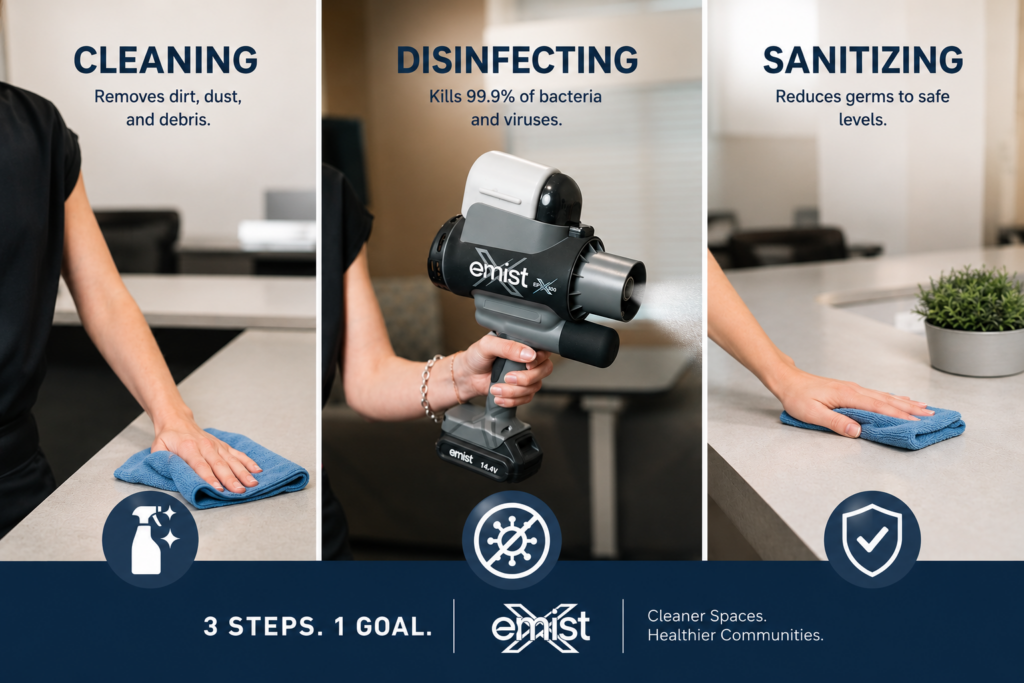
1. Cleaning: The Foundation of Every Healthy Facility
Cleaning is the first and most fundamental step in maintaining any facility. Its primary purpose is to remove visible dirt, dust, debris, grease, and many germs from surfaces using soap or detergents and water or another appropriate cleaning solution.
Although cleaning removes many contaminants, it does not necessarily kill microorganisms. Instead, it physically lifts and removes them from surfaces. This is why cleaning is considered the foundation of an effective maintenance program.
Routine cleaning helps:
- Remove dirt and debris
- Improve the appearance of a facility
- Reduce dust and allergens
- Prepare surfaces for sanitizing or disinfection
- Support overall facility maintenance
Examples of routine cleaning include vacuuming carpets, mopping floors, wiping desks, washing windows, emptying trash bins, and cleaning restrooms.
Without proper cleaning, residues left behind can reduce the effectiveness of sanitizers and disinfectants. Starting with clean surfaces helps ensure the next steps perform as intended.
2. Sanitizing: Reducing Germs to Safer Levels
Sanitizing goes a step beyond cleaning by reducing the number of germs on a surface to levels considered safe by public health standards. While sanitizing does not eliminate every microorganism, it lowers the amount of bacteria on a surface to help reduce the risk of disease transmission.
Sanitizing is commonly used in environments where food is prepared or served because food-contact surfaces have specific regulatory requirements.
Common places where sanitizing is frequently used include:
- Restaurants
- Commercial kitchens
- Cafeterias
- Food processing facilities
- Childcare centers
- Breakroom food preparation areas
Items that are often sanitized include:
- Food preparation counters
- Cutting boards
- Dining tables
- Highchairs
- Kitchen equipment
- Food-contact utensils
Sanitizers are designed for specific applications and should always be used according to the manufacturer’s directions.
While sanitizing is an important part of many cleaning programs, there are situations where disinfection may be the more appropriate next step, particularly in environments with increased exposure risks.
3. Disinfection: Targeting Disease-Causing Microorganisms
Disinfection is the process of using an EPA-registered disinfectant to kill or inactivate many disease-causing microorganisms on hard, nonporous surfaces after they have been cleaned.
Unlike cleaning, which removes dirt, or sanitizing, which reduces germs to safer levels, disinfection is designed to address pathogens that may remain on surfaces.
Proper disinfection requires following the disinfectant manufacturer’s label instructions, including:
- Required contact (dwell) time
- Proper dilution
- Approved surfaces
- Safe application methods
Common areas that benefit from routine disinfection include:
- Door handles
- Light switches
- Elevator buttons
- Shared keyboards
- Conference room tables
- Reception counters
- Restroom fixtures
- Breakroom appliances
- Handrails
- Shared office equipment
Healthcare facilities, schools, offices, gyms, hotels, public transportation, and government buildings often incorporate disinfection into their regular maintenance schedules because these environments experience frequent contact with shared surfaces.
EPA List N Tool: COVID-19 Disinfectants
How the Three Work Together
Rather than thinking of cleaning, sanitizing, and disinfection as competing options, it’s more helpful to think of them as tools used for different purposes.
A typical workflow may look like this:
Step 1: Clean the surface by removing dirt, dust, grease, and debris.
Step 2: Determine whether sanitizing or disinfection is appropriate based on the environment and intended use.
For example:
- An office desk may be cleaned regularly and periodically disinfected.
- A restaurant prep table is cleaned and then sanitized before food preparation.
- A healthcare exam room is cleaned and then disinfected between patients.
Selecting the right process depends on the type of surface, how it is used, and the level of hygiene required.
The Role of Electrostatic Application in Disinfection
Large facilities often contain hundreds, or even thousands, of high-touch surfaces that require routine attention. Maintaining consistency across these environments can be challenging using traditional application methods alone.
Electrostatic sprayers apply an electrical charge to disinfectant droplets as they leave the sprayer, helping them become attracted to hard, nonporous surfaces. This can improve coverage around complex shapes and hard-to-reach areas while supporting more efficient disinfection when used according to the disinfectant label.
For schools, healthcare facilities, office buildings, hospitality venues, and other large commercial spaces, electrostatic application can help facility teams maintain consistent disinfection practices across larger areas while saving time.
Choosing the Right Approach
Creating healthier environments isn’t about choosing between cleaning, sanitizing, or disinfection; it’s about understanding when each one is appropriate.
- Cleaning removes dirt, dust, and debris while preparing surfaces for additional treatment.
- Sanitizing reduces germs to levels considered safe for specific applications, especially food-contact surfaces.
- Disinfection targets many disease-causing microorganisms on cleaned, hard, nonporous surfaces using EPA-registered disinfectants.
When these practices are used together as part of a comprehensive facility maintenance program, organizations can help create cleaner, healthier, and more welcoming environments for employees, customers, students, patients, and visitors. By understanding the purpose of each step, facility managers and cleaning professionals can make informed decisions that support both cleanliness and infection prevention every day.