Electrostatic disinfection is transforming how facilities approach high-touch surface cleaning. Across industries, including education, healthcare, hospitality, transportation, and commercial environments, electrostatic disinfection reduces cleaning time while lowering labor costs.
When disinfection is required daily, efficiency becomes critical. Electrostatic disinfection delivers both time savings and labor savings in a measurable way.
The Time Problem with Manual Cleaning
Traditional spray-and-wipe cleaning is repetitive and slow. Staff must:
-
Aim and spray
-
Adjust position
-
Wipe and spread disinfectant
-
Move to the next surface
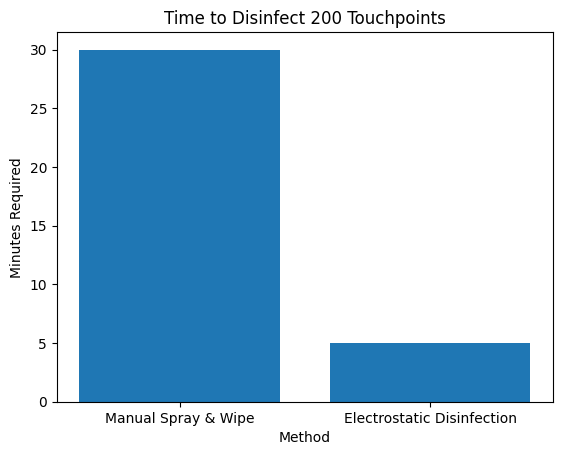
Disinfecting 200 touchpoints manually takes about 30 minutes.
With electrostatic disinfection, those same 200 touchpoints can be covered in approximately 5 minutes.
That is a 25-minute time savings per 200 touchpoints.
Time is not just a convenience; it directly impacts labor hours, staffing needs, and operational flow.
How Time Savings Become Labor Savings
Every 25 minutes saved equals 0.42 labor hours.
At a $20 per hour labor rate, electrostatic disinfection saves about $8.33 per 200 touchpoints.
But facilities rarely disinfect only 200 surfaces.
In most buildings, it is common to reach:
-
3,000 touchpoints per day
-
5,000 touchpoints per day
-
10,000 or more touchpoints per day
Example: 3,600 touchpoints daily
3,600 ÷ 200 = 18 sets
18 × 25 minutes saved = 450 minutes saved
450 ÷ 60 = 7.5 hours saved per day
That equals:
7.5 hours × $20/hr = $150 saved per day
Over a year, electrostatic disinfection can generate tens of thousands of dollars in recurring labor savings, simply by reducing cleaning time.
Time Savings Across Industries
Electrostatic disinfection improves operational speed in multiple environments.
Education
Schools manage daily classroom turnover and shared spaces. Electrostatic disinfection reduces cleaning time between class periods and after school hours.
Healthcare
Hospitals and clinics rely on rapid room turnover. Electrostatic disinfection supports faster patient flow by reducing disinfection time.
Hospitality
Hotels clean rooms and public areas daily. Electrostatic disinfection shortens turnover windows and eases housekeeping pressure.
Commercial Facilities
Office buildings and shared workspaces require consistent cleaning schedules. Electrostatic disinfection reduces total labor hours required to maintain standards.
In every industry, time saved directly translates to labor savings.
Why Electrostatic Disinfection Is Faster
Electrostatic disinfection applies a charged mist that wraps around surfaces. Instead of treating each angle separately, electrostatic disinfection coats exposed and hidden areas in one pass.
This shifts cleaning from a surface-by-surface method to area-based coverage.
The result is:
-
Reduced application time
-
Fewer repeated passes
-
Less physical strain on staff
-
More consistent surface coverage
Electrostatic disinfection improves efficiency without sacrificing performance.
The Operational Advantage
The investment in electrostatic disinfection equipment is fixed.
The time savings and labor savings from electrostatic disinfection are recurring.
When facilities reduce daily cleaning time by several hours, they can:
-
Lower overtime
-
Reallocate staff
-
Increase coverage without increasing headcount
-
Improve workflow and turnaround speed
Electrostatic disinfection does not just reduce cost; it increases operational flexibility.
Final Thoughts
Electrostatic disinfection saves time.
Electrostatic disinfection saves labor.
Across industries, facilities are under pressure to do more with fewer resources. By reducing application time while maintaining consistent coverage, electrostatic disinfection becomes one of the most practical efficiency tools available.
When disinfection is part of daily operations, electrostatic disinfection turns time savings into a measurable financial impact.